Chapter 1
11
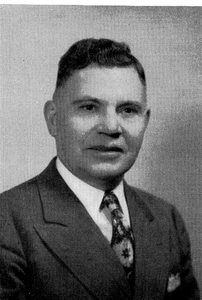
Photograph of Morris Goldowsky

12
Part 1: Childhood Years
13
Chapter 1
When I was still a child, I longed very much for a grandfather and a grandmother. I could not understand why all the other children had grandfathers and grandmothers, but I did not. So I asked my father to tell me why this was so.
GPT uses a mix of translation and transliteration here, we need to decide how to render some of these words. guberniya is a larger geographical region than a district, presumably. There are similar issues throughout the following.
Also TBD would be nice to link to a map.
He told me that his father and mother—that is, my grandfather and grandmother—had lived in a small town called Khalfmetch, in the Rechitsa district of Minsk guberniya1. My grandfather’s name was Moses Goldowsky, and my grandmother’s name was Malka.
My grandfather was a melamed, a teacher who prepared older children for the yeshiva. Once, when my father, Ben-Zion, was studying at the Petrikov yeshiva, he received news on a certain day in the month of Shevat that his father had died of a severe chill.
My father immediately went home, and my grandmother told him the following story. There had been a very severe frost. On Friday afternoon, my grandfather went to the bathhouse so that he could immerse himself in the mikveh in preparation for the Sabbath. He found the bathhouse cold and the water partly frozen. But this did not stop him from immersing himself in the frozen mikveh in honor of the Sabbath.
The result was that he caught a severe chill, and about two weeks later he died. My grandmother took his death very much to heart, and about a week later she, too, died.
Two sons were left behind: my father, Ben-Zion, and an older son, Jacob. My uncle Yankel was a shochet, a ritual slaughterer, and he obtained a position as the town slaughterer in Chernobyl. My uncle then took his younger brother, Ben-Zion, to live with him in Chernobyl.
14
My father studied at the yeshiva there and soon received semikhah, rabbinical ordination. The rabbi, Reb Motele, then took him into his household to teach his two sons, Hershele and Brukhl, both of whom were already grown young men. Hershele was about the same age as my father, while Brukhl was three years younger.
Living in the rabbi’s house was his niece, an orphan named Khane-Leye. She was very beautiful and was a good student. My father married her, and my parents settled in Chernobyl.
By the time they had three children—two sons and a daughter—and my mother was expecting a fourth, Reb Motele moved to the town of Loev, in Minsk guberniya, taking my father and the entire family with him.
When they arrived in Loev, the rabbi proposed that my father become his meshulakh, his traveling emissary. The rabbi’s two sons were already married and living independently, and the older one had received rabbinical ordination.
My father needed to support a wife and four children, so he accepted the position. His work was to travel around all the towns and small towns where the rabbi had followers, teach them Torah, and collect pidyonot—contributions made to the rabbi. Sixty percent went to the rabbi, and my father received forty percent.
My father was also a great singer, and he would take jobs leading the prayers before the congregation during the High Holy Days. His sons would help him with this. Our entire family loved singing.
All this happened before I was born. I was born in April 1884 in Loev, the fifth child in the family. Our family continued to grow: my parents had ten children, six sons and four daughters.
15
I remember that when I was four years old, I asked my mother why the shkotzim—the non-Jewish boys—didn’t wear shoes, while I wore shoes and socks.
My mother answered that the shkotzim ate pork, so they were healthy and could walk around barefoot without catching cold. Jewish children, she said, were weak and must not walk around barefoot.
“And why do some children go around in torn clothes, while I wear whole ones?” I asked next.
My mother answered that those mothers were too lazy to mend their children’s clothes, and that was why the children went around in rags.
When I turned five, I was sent to kheyder, the traditional Jewish elementary school.
The first time, my mother took me there herself. My teacher was named Tanhum. He had no beard and wore a wig with two long payes—side curls. He looked very strange to me. When I looked at him, I became frightened and ran out of the schoolroom.
A couple of older boys caught me and brought me back inside. My mother had told me that when I went to kheyder, an angel would drop pennies down for me. And that is exactly what happened: as soon as the teacher began teaching me the alef-beys, several pennies fell down.
I was a great mischief-maker, and all the boys wanted to play with me and treated me well. I was always the oldest in the groups of friends. I was also strong, and I would stand up for other people when they were wronged.
My brothers and sisters—even the older ones, not just the younger ones—would tell me whenever someone had treated them badly, and I would stand up for them.
16
A cousin of my father’s, whose name was Mirke, often used to take me to her home for a few days. She was exceptionally kind to me, and I loved her too. She was a very good and pious woman.
TBD decide on how to render names. Moshe-Yisroel (suggested by Claude) might read better as a culturally-appropriate name than the anglicized "Moses Israel" given by GPT here.
She did not call me Moses, but Israel. When I was born, she had asked my parents to give me the name Israel, after her father. So I was given the name Moses-Israel: Moses after my grandfather, and Israel after her father. But everyone at home called me Moses; only she called me Israel.
I did not do particularly well at kheyder. I did not like the teacher. Once, the teacher slapped me, and I jumped up and pulled off his long payes—they were artificial side curls—and ran home with them.
My mother was very angry with me and ordered me to take the payes straight back to the teacher. I obeyed her because I loved my mother very much. All of us children loved her because she was so affectionate and beautiful, tall and slender. She never shouted at us children; she asked things of us instead, and we always obeyed her.
When I returned the payes to the teacher, he told me to tell my mother to find me another melamed.
The next morning, my mother went with me to the schoolroom and asked the teacher to take me back, but he refused. So she took me to another teacher, Reb Leyb Yok Manizil—that was what everyone called him because he had a little goat-like beard.
There I met a couple of my friends, with whom I used to play tsurki-palki. I studied with him for several school terms. The teacher was very strict and had a leather “lokshn”—a strap or whip. Whenever a boy misbehaved, he would beat him wherever he could reach him.
17
Once he gave me a beating, and at that very moment his wife called to him. I seized the “lokshn” and hid it.
The teacher came back and searched for it, but could not find it. He asked everyone, but each boy said he knew nothing. Then he brought handkerchiefs and ordered everyone to blindfold himself.
After that, he shouted, “May the hat of whoever took the lokshn catch fire!”
I instinctively grabbed my own hat. The teacher then came over to me and ordered me to hand over the lokshn. When I answered that I did not know where it was, he pulled my ears very hard. I tore myself free of his hands and ran home.
I told my mother that I did not want to study with a teacher who was a robber.
My father happened to be home at the time. He did not think much of this teacher either, so he told my mother that the best thing would be for me to go with my older brother Abraham to the village where Abraham taught the children of a yishuvnik—a Jewish villager or small-settlement resident—near Dobronke. When Abraham came home for the Sabbath, they could send me back with him, and he could teach me.
I was delighted with this idea, and my brother Abraham readily agreed to take me to the village.
When we arrived, we stopped at an inn. My brother said to me, “This is where I teach the householder’s children: one boy and two girls. The boy is about my age, and the two girls are much older.”
I greeted them. Their mother, a stout Jewish woman wearing a little red dress and a green kerchief on her head, came over and asked me, “What is your name?”
“Israel-Moses,” I answered.
“We’ll call you Moisey,” [this is a more Russian/Slavic version of the name] she said. “Would you like something to eat?” she asked me. Without waiting for an answer, she took me by the hand and led me into another room.
18
“Sit down and eat,” she said.
Her husband was already seated at the table. He was a big, solidly built Jewish man, tall and stout, with a large yellow beard and thick eyebrows.
The mistress of the house said to him, “This is the teacher’s brother.”
The master of the house greeted me with shalom, and he shook my hand so vigorously that he hurt it for a good couple of minutes while exchanging the customary shalom aleichem greetings.
They served food: herring, potatoes, sour cream, butter, black bread, and a large bowl of milk. Everyone sat at the table respectfully. The father made sure that everyone ate. When he looked at someone with those eyes of his, one could be frightened of him.
They gave me a place to sleep in the barn, where there was a great deal of hay. And the hay smelled wonderful.
I studied with my brother in the village for an entire school term. When I returned home, I was so fat and sunburned from the good food and the sun that people hardly recognized me.
I came home because my brother Abraham had refused to continue teaching the yishuvnik’s children: one of the girls had fallen in love with him. Since he had long had a fiancée back home, he no longer wanted to stay with the yishuvnik.
He opened a kheyder in Loev, in the house of his fiancée’s mother; her father had died. I continued studying with him there.
His fiancée was named Sarah. She was a dressmaker who sewed clothes for the wealthier householders’ wives. She was small and thin, but pretty-faced and clever.
Every morning, when I came into the schoolroom, she would ask me how everyone at home was doing and whether I was hungry. In the middle of the day she would bring me a bagel with milk, and I was grateful to her for it.
A couple of times a day, she would bring my brother Abraham something to eat. If he ever refused to take it, she would scold him, and he was already afraid to refuse her a second time.
19
Sarah also had a brother and an older sister. Their mother baked bagels, which she sold from their home. The older daughter helped both her mother and Sarah. Her brother also studied with my brother Abraham.
Sarah was the real mistress of the household. Though she was small, she managed to get things done with everyone, and everyone had to obey her. Otherwise, there was hell to pay.
My brother Abraham was very handsome. He was good at studying and at singing. In the evenings he would spend time with his friends. He would organize theatrical performances, such as Bar Kokhba and The Binding of Isaac. He usually took the leading roles.
Everyone in the town loved him, and people wondered why he had fallen in love with Sarah. Others would joke that it was fate that an Abraham should have to marry a Sarah.
My father, as the rabbi’s meshulakh, was seldom at home. He traveled from town to town collecting pidyonot for the rabbi. When my mother announced the good news that Father was coming home, we children were filled with joy.
Whenever my mother and my older sister, Malka—this was her name—received letters saying that Father was coming home, they immediately became very busy. They cleaned and prepared the house for the Sabbath as if for a holiday.
The boys would wash the floors throughout the house, which consisted of two alkers (a term in the original whose precise household meaning is uncertain), a large kitchen, and a dining room. Malka and my mother would comb all the children’s hair and dress us in our Sabbath clothes.
My father always came home for the Sabbath. In summer, we children would sit outside on the prizbe—the raised area or bench beside the house—and wait for him. In winter, we would stand at the windows and look out for him.
20
When Father arrived by steamboat, all the children would go to meet him, with my sister Malka at the head of the procession, the younger ones in front and the older ones behind them.
The whole town knew that when people saw Ben-Zion’s children marching down the street, it meant their father was on his way home from his travels. Nothing made us children happier than going to meet him. The younger children would greet him first, followed by the older ones.
My father was very handsome. He was a little taller than my mother and was not stout. He had a handsome, slightly graying beard and short, curled payes.
He wore a long black coat, half-boots, long white socks, black trousers tucked into the socks, a waistcoat with a watch chain and a watch in the waistcoat pocket, a black hat, and beneath it a silk yarmulke. A large handkerchief always protruded from his back pocket.
When my father walked away from the steamboat, surrounded by his children, people would stop and watch him, and then come over to greet him with shalom aleichem. Those standing farther away would say, “The rabbi’s right hand is here! What a Sabbath it will be in the rabbi’s synagogue!” For when my father returned, he would lead the prayers before the congregation.
As soon as Father entered the house, after greeting everyone he would say to Mother, “My eshet chayil ["woman of valor", a traditional honorific for a wife, from Proverbs 31], have you had to work hard?”
Mother would answer, “No, Reb Ben-Zion”—she called him Rabbi Ben-Zion—“our dear children, may they be healthy, have played a large part in keeping the house in order.”
The samovar would already be standing on the table, and if it was still early, some food would also be ready.
21
After that, Father, together with the younger sons -- bonim, he called us [he uses the formal Hebrew word rather than the ordinary Yiddish zin] —- and go to the bathhouse and the mikveh in honor of the Sabbath.
When he returned, he would distribute to everyone the gifts he had brought back from his travels. He gave the first gift to Mother, then to my older sister, then to my older brother. After that, he would hand out each child’s own gift, making sure that no one felt slighted.
He knew what each child liked and brought each of us something to suit our tastes.
Then he would take Mother and the younger children and go to the rabbi’s synagogue. My older sister would stay home to prepare the table.
notes from ChatGPT:
- Khalfmetch (כאַלמעטש): I’ve retained the place-name as a transliteration. The scan supports the Yiddish spelling, but I haven’t established a reliable modern place-name equivalent.
- Reb Leyb Yok Manizil (ר’ לײב יאָק מאניזיל): The name is unusual, and I would not confidently normalize its spelling without another source.
- Tsurki-palki (צורקי־פּאלקי): This appears to be the name of a children’s game. I’ve left it transliterated rather than guessing at its rules.
- “The rabbi’s right hand”: This is a figurative expression for the father’s close role as the rabbi’s trusted representative.