Chapter 8
67
Chapter 8
They travel north to the shores of the White Sea rather than east to Siberia. Arkhangelsk and Kem are about 300km apart by sea, considerably farther by land.
We spent two weeks in the Butyrki. Then our long journey to Siberia began. On the way we were told that, because a war had broken out between Japan and Russia, we would be taken to Arkhangelsk province1. The journey took about three weeks. From Arkhangelsk we were taken on foot, but Frida and the children rode on a cart pulled by dogs. At long last we arrived in the village of Kem. We were brought to a house where we found a group of eleven men and five women. One of them was the writer Shulatikov, whom I had met earlier in Odessa. He wrote for Iskra and had served with Plekhanov on Iskra’s central committee.
We spent two weeks in the Butyrki. Then our long journey to Siberia began. On the way we were told that, because a war had broken out between Japan and Russia, we would be taken to Arkhangelsk province. The journey took about three weeks. From Arkhangelsk we went by foot, but Frida and the children rode on a cart pulled by dogs. At long last we arrived in the village of Kem. We were brought to a house where we found a group of eleven men and five women. One of them was the writer Shulatikov, whom I had met earlier in Odessa. He wrote for Iskra and had served with Plekhanov on Iskra’s central committee.
All of them were political exiles, and they all lived together as one commune. Each day it was different comrades’ turn to cook, serve the meals and keep the house clean. Frida and I were taken into the commune. I was very tired from the journey and waited impatiently for night to fall so that I could go to sleep. But night didn’t come. Some of the comrades asked me why I wasn’t going to bed, since it was already late. I told them I was waiting for it to get dark. They burst out laughing and explained that here it only got a little dark, and only around dawn. In winter, on the other hand, it was dark all the time, and only in the middle of the day did it get a little lighter.
68
The village of Kem had barely a hundred houses. The village’s native inhabitants were Karelians, who came originally from Finland. They lived mainly by fishing and by hunting in the forest, mostly for deer. Two families in the village bought up the fish and the animal skins and gave the peasants potatoes, kerosene for their lamps and cooking oil in exchange. There were also two desyatniki [overseers] in the village to keep watch over the political exiles. A house was found for me and my family. We only lived there, though; for meals we went to the commune house. Everyone put in the money we got from the government, eight rubles a month. Some of the comrades, myself among them, were also sent a few rubles each by the party, and we put half of that money into the commune too. Most of the political prisoners were Social Democrats; three were Socialist Revolutionaries, one was an anarchist and one a Bundist. We were free all day long and had no work at all, so we held long discussions and played chess and dominoes. There were a couple of students among us, and they gave lectures for the rest of us. At that time the split into Mensheviks and Bolsheviks had just flared up, and we spent a great deal of time debating it.
Among us there was also a young woman, the daughter of a general in the Russian army. Her parents sent her a lot of money. Her name was Maria Fyodorovna. She made up her mind to escape. But she had a big dog that was very attached to her, so the question was what to do with the dog. It took several weeks to wean the dog away from her. Then she was put into one of the big baskets that were used for fish, and together with the baskets of fish, her basket was loaded onto a cargo ship that was leaving for Arkhangelsk.
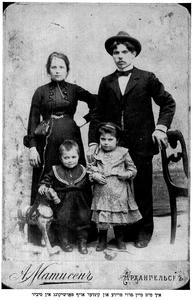
Photograph of the family in exile
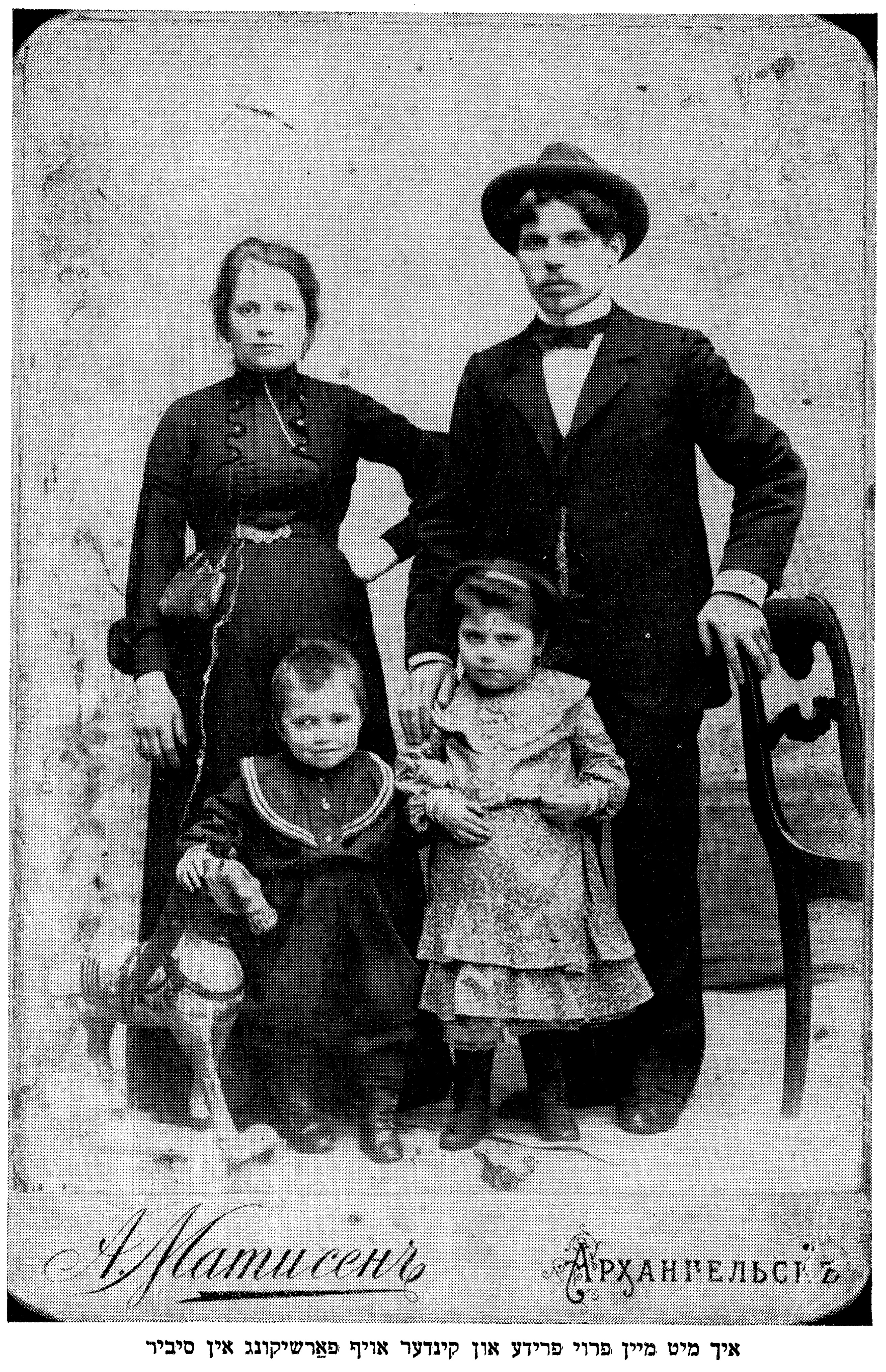
Image credit: The photographers stamp reads А. Матисенъ / Архангельскъ (A. Matisen, Arkhangelsk).
69
The days and nights dragged on, one like the next, and so did the cold. Even in July and August it was cold, and you had to wear a coat. In winter the frost was so fierce that if you poured out a little water, it hit the ground as a lump of ice. We went about in felt boots and big fur coats, with big kuchmas [tall fur hats] on our heads that came down past our necks. Once, in the month of Shevat [January–February], I saw through the window that it had grown very bright outside. I went out to see what it was, and in front of me I saw a wall of many-colored rays stretching from the sky down toward me. I stood there frozen stiff with wonder. If Frida hadn’t called me back into the house, I might really have frozen. It was the northern lights (in Russian they’re called severnoye siyaniye).
After some time we were transferred to Onega, not far from Kem. The political exiles had a commune there too. Onega was a little bigger than Kem. Its inhabitants were also Karelians. But in the taiga [northern forest], not far from the village, there also lived Laplanders, or Lapps. They lived in huts of moss [heyln, literally “caves”] and owned big herds of reindeer. They looked dreadful: short, with flattened noses and small ears. When they talk, they squeal very loudly. They go about dressed in reindeer skins. As for the Karelians, people said they had once been cannibals. Now they no longer eat people, except that when one of their own dies, they eat him.
70
This is Friedel, probably so named to honor his mother. It would fit with Ashkenazi tradition to name a child after their mother who died in childbirth.
Suddenly a great misfortune befell me. Frida bore me another son2, and soon after giving birth she came down with pneumonia, and within a few days she was dead. For me it was a terrible tragedy. I was left all alone with three small children, one of them a baby only a few days old. The whole village walked behind Frida’s coffin. The comrades turned the funeral into a demonstration and sang the song “Vy zhertvoyu pali” [“You fell victim,” the revolutionary funeral march]. The comrades helped me a great deal in caring for the children.
The Severo-Zapadny Komitet [North-Western Committee] of the Russian Social Democrats let me know that it wanted me to escape from exile and come back to work. It was the beginning of 1905, and the revolution could already be felt in the air. The committee sent me enough money, and also a false passport belonging to a monastery deacon. I disguised myself as a deacon: I let my hair grow long, put on a long coat and took a big staff in my hand. That is how I escaped to Arkhangelsk together with the children.
We rested there for a few days. Then I took the train to Moscow. When I arrived at the Moscow station, where I had to change trains, gendarmes stopped me. They told me they had orders to arrest me. I kept crossing myself and praying, with my eyes on a Gospel. They took me into a side room at the station and gave me milk for the children. Soon an older gendarme arrived. He ordered them to check whether the youngest child, a little boy, was circumcised. He wasn’t. That meant, of course, that I was no Jew. So they apologized to me and kissed my hand, and when the train came in, they helped me board the carriage with the children.
71
I rode only two stations. There I got off the train and went to an inn, where I spent the night. The next morning I set out by another route. I wrote to Frida’s parents that I was sending the three children to them, that a deacon would bring them, and that they should wait for him at the Kalinkovichi station.
I arrived with the children and met Frida’s father and brother. They didn’t recognize me. I handed over the children to them, along with a hundred rubles and the things that were left of Frida’s. They still didn’t recognize me. When I got ready to leave, the children burst into tears. The father said to my eldest: “Khanele, don’t cry, your papa wrote me that he’ll come to you soon.” But the child didn’t understand any Yiddish, because in Siberia everyone had spoken only Russian with her.