From Long Ago to Today: My 60 Years of Life and Struggle in the Workers’ Movement
By Morris Goldowsky
New York, 1959
Printed in the United States
Futuro Press, 476 Broadway, New York 13, N.Y.
Contents
- Foreword by N. Khanin
- Greeting by Morris Kovler
- Morris Goldowsky — A Complete Trade Unionist and Socialist — by Y. Fogel
- Foreword by the Author
- Part One: Childhood Years
- Part Two: In the Russian Revolutionary Movement
- Part Three: “Green Years” in America
- Part Four: Building the Jewish Workers’ Movement
- Part Five: Summing Up a Life
A Foreword
This section is by
Nokhum (Nathan) Khanin (1885/86–1965), Jewish socialist, labor leader, Yiddish writer, and Workmen's Circle leader.
CJC Page
I read the manuscript of our comrade Morris Goldowsky with great interest.
I am a lover of memoirs. Every book or manuscript of this kind that
falls into my hands, I read with the greatest interest. I have a
special interest in the memoirs of people who come from shap, or who
have been and are active in the Jewish workers' movement. The reason
for my special interest perhaps lies in the fact that the life they
have lived through is, to a great extent, also my life.
Most of the memoirs of this kind that I have read are by people who
began their activities in the Old Country in the socialist or other
revolutionary movements; they later came to America, remained faithful
to the workers' movement, and here continued their activities with the
same socialist enthusiasm as in the Old Country.
Morris Goldowsky begins his memoirs with his childhood years. A boy
from a religious Jewish home, he became a socialist; precisely at that
time—and in this respect he was an exception—when socialist thought
among Jewish workers was dominated by the Bund, he instead became very
active in the “Gvishar” socialist movement, which among us in
Lithuania was known under the name “Iskra.” According to his
descriptions, he was very active and went through all the paths of a
revolutionary in the Old Country: prison, Siberia, etc.
When he came to America and became a presser here, he devoted his
entire life to the “International.”
When I read memoirs, it is not important to me whether all the facts
are historically exact, because I am certain that he has described all
the facts and events as they were reflected in him and remained in his
memory. And that gives a true picture of the person and of his life.
I read every chapter with great interest. Each chapter refreshed in my
memory a great many moments from our life and struggle during the past
50 years. From this standpoint alone, it is an interesting book and
one that reads with great interest.
The socialists of the Old Country, the active workers in the Jewish
workers' movement during the past 50 years, and also the cloakmakers,
will read this book with great interest.
– N. Khanin
5
A greeting
This section is by Morris Kovler. I didn't find much about him,
but he's listed in a Cornell Archive of union correspondence
in his capacity as manager of the ALGWU.
On the occasion of the publication of this book of memoirs by our
brother Morris Goldowsky, it is more than fitting that the manager of
the Cloak Pressers Union, Local 35, where Goldowsky spent many years
as an officer, should greet him for undertaking to describe in a book
his personal life story, which is closely connected with the history
of our Cloakmakers’ Union and of our Local 35.
Life endowed our brother Morris Goldowsky with the gift of being an
observer with a good nature: of being able to get along with and
befriend people—and to work together with them in the various trade
unions and socialist organizations where he happened to be one of the
leaders or active co-workers. As such, with his good qualities, I
remember him as an officer of our Cloak Pressers Local 35, from which
he retired from his work several years ago, after decades of activity.
It may be that Morris Goldowsky is the most suitable person to convey
the historical facts of the last half-century, because during the more
than four decades that I myself have been connected with Local 35,
there truly was not a single important moment around us in which
Goldowsky was not directly involved. Thus, one cannot pass over the
great, historic Cloakmakers’ strike of 1910 without finding Goldowsky
there.
6
We come to the year 1916, the year of the struggle for the existence
of the Cloakmakers’ Union—and here too Goldowsky was involved. We come
to the difficult and bitter period of strikes in the by-then
established Cloakmakers’ Union, and here too we encounter
Goldowsky. The “Jewish Gewerkschaften” [Jewish trade unions], where
Goldowsky is now president, he also helped in the work on all fronts
throughout the many years of their existence.
Now, as that half-century—the “golden era” of building and struggle—is
being brought to a close, Morris Goldowsky appears as one who
participated in every struggle for a better life here in America, just
as he had begun doing in his earlier youth in Tsarist Russia . . .
Therefore we greet him here, in the name of the union and in our own
name, on the publication of his book—a description of the era that has
passed. This book certainly deserves that everyone who has any
interest at all in that period should take the trouble to read it.
– Morris Kovler,
Manager of the Cloak, Suit, Skirt and Sportswear Pressers Union, Local 35, A. L. G. W. U.
7
Morris Goldowsky — A Complete Trade Unionist and Socialist
This section is by Y. Fogel, but I'm not sure who that was. TBD.
Just as Morris Goldowsky devoted a large part of his productive life
to the trade-union movement, so, in describing his socialist activity,
we will use an industrial comparison.
In the needle trades, such a term as section work is well known. This
is a system of production in which each part of the “garment” is made
by different hands. The operation can be learned in no time, and it
does not require any particular skill. But the old-time tailor, who
was skilled in his craft, knew the “garment” from aleph to tav [from A
to Z], and he truly put a great deal of knowledge and artistry into
his work.
We use this comparison when we think about Goldowsky.
His socialism is not a section-work operation. He does not fulfill his
socialist obligations piecemeal; he is a complete socialist, without
deviation and without excuses.
Goldowsky comes from the pressers’ room. Pressers, as is well known,
are practical, prosaic fellows, and they have never been much given to
the ‘sin’ of being dreamers and simply being socialists. Goldowsky,
however, is a rare exception in this regard: he has always fought for
practical things, and at the same time he has infused practical
matters with his faith in a new socialist order.
8
He could speak enthusiastically about “raising the wages,” as cloak
pressers put it, and immediately afterward speak with ecstasy at a May
Day demonstration.
Goldowsky has always embodied a synthesis between the practical trade
unionist and the visionary socialist. Indeed, it is these two
qualities that caused our movement to put down roots in Jewish life in
America.
The path Goldowsky follows throughout his entire life is, in fact, the
path of the Jewish workers’ movement. It is the way of combining
practicality with dreaminess, bread with roses, hard reality with the
world of the future.
Goldowsky, therefore, is not a section socialist, but a complete socialist, 24 hours a day.
I am certain that his book, which contains his [substantial / rich] biography,
reflects in a striking manner the whole Goldowsky.
If our trade-union movement had had more Goldowskys, perhaps the
socialist spirit would not have become so diluted and flattened,
because crooked paths can be avoided only when one has faith in one’s
heart. That faith exists in Goldowsky’s heart.
– Y. Fogel
9
Foreword by the Author
With this autobiography of mine, I do not pretend to write history. I
merely wanted to tell the life story of a poor Jewish boy from a
religious home who, already in his earliest youth, attached himself to
the liberating socialist movement; who passed through the great storms
of our time—the First Russian Revolution, exile to Siberia, emigration
to America, and participation in the pioneering building of the Jewish
workers’ movement in America.
I have described all this here not as objective history, but as it was
reflected in my life and as it forged my life. When I began writing
these memoirs, I had already been active in the workers’ movement for
60 years, first in the Old Country and afterward here, in America. I
was active in it continuously throughout that entire time and served
it faithfully as best I could.
How much I gave to the workers’ movement I cannot judge; that can
better be judged by the reader who becomes acquainted with this
book. But one thing I do know: the workers’ movement personally gave
me a great deal—it gave me an ideal and a rich content in life, and it
helped me find a solution to many difficult moments in life.
As an expression of my loyalty to this movement, which I served
throughout my life, I have written these memoirs.
10
I want to express my heartfelt thanks to my old good friends and
comrades in the struggle, N. Khanin, Morris Kovler, Y. Fogel, and
William Wolpert, who formed the committee to publish my book. I thank
them for their friendly words with which they open this book, and for
their help in general, without which this book could not have seen the
light of day.
Finally, I want to express my hope that these memoirs of mine will be
a useful contribution to the great and glorious history of the Jewish
workers’ movement on both sides of the ocean.
– M. G.
11
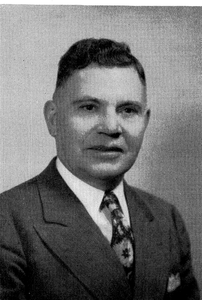
Morris Goldowsky, photographed in 1951

Morris Goldowsky, photographed in 1951
12
Part 1: Childhood Years
13
Chapter 1
When I was still a child, I longed terribly for a grandfather and a
grandmother. I could not understand why all the other children had
grandfathers and grandmothers, but I did not. So I asked my father to
tell me why this was so.
He told me that his father and mother—that is, my grandfather and
grandmother—had lived in a small town called Kholmech, in the
Rechitsa district of Minsk province.
My grandfather’s name was Moyshe Goldowsky,
and my grandmother’s name was Malka.
My grandfather was a melamed, he prepared older boys
for the yeshiva.
Once when my father Ben-Zion was studying at the yeshiva in Petrikov,
he received news one day in the month of Shevat that his father had
died of a severe chill. My father immediately traveled home, and my
grandmother told him the following story. There had been a very severe
frost. On Friday afternoon, my grandfather went to the bathhouse so
that he could immerse himself in the mikveh [ritual bath] in
preparation for the Sabbath. He found the bathhouse cold and the
water partly frozen. But this did not stop him from immersing himself
in the frozen mikveh in honor of the Sabbath.
The result was that he caught a severe chill, and about two weeks
later he died. My grandmother took his death very much to heart, and
about a week later she, too, died.
Two sons were left behind: my father, Ben-Zion, and an older son,
Yankev. My uncle Yankl was a shochet [a ritual slaughterer], and he had
obtained a position as the town shochet in Chernobyl.
14
My uncle then took his younger brother, Ben-Zion, to live with him in
Chernobyl.
My father studied at the yeshiva there and soon received
rabbinical ordination. The Rebbe, Reb Motele, then took him into his
household to teach his two sons, Hershele and Borekhl, both of whom
were already grown young men. Hershele was about the same age as my
father, while Borekhl was three years younger.
Living in the rabbi’s house was his niece, an orphan named Khane-Leye.
She was very beautiful and well educated.
My father married her, and my parents settled in Chernobyl.
By the time they had three children—two sons and a daughter—and my
mother was expecting a fourth, Reb Motele moved to the town of
Loyev, in Minsk province, taking my father and the entire
family with him.
When they arrived in Loyev, the rabbi proposed that my father become
his meshulakh [traveling emissary]. The rabbi’s two sons were
already married and living on their own, and the older one had
received rabbinical ordination.
My father needed to support a wife and four children, so he accepted
the position. His work was to travel around all the towns and
villages where the rabbi had followers, give them words of Torah,
and collect pidyoynes [offerings] for the Rebbe.
Sixty percent went to the Rebbe, and my father received forty percent.
My father was also a fine singer, and he would take jobs leading the
prayers before the congregation during the High Holy Days. His sons
would help him with this. Our entire family loved singing.
All this happened before I was born. I was born in April 1884 in Loyev,
the fifth child in the family. (Our family kept growing: my
parents had ten children, six sons and four daughters.)
15
I remember that when I was four years old, I asked my mother why the
shkotzim [gentile boys] didn’t wear shoes, while I wore shoes and
socks. My mother answered that the shkotzim ate pork, so they were healthy
and could walk around barefoot without catching cold. Jewish children,
she said, were delicate and must not walk around barefoot.
“And why do some children go around in torn clothes, while I wear
whole ones?” I asked next. My mother answered that those mothers were
too lazy to mend their children’s clothes, and that was why the
children went around in rags.
When I turned five, I was sent to cheder.
The first time, my mother took me there herself. My teacher was named
Tankhem. He had no beard and wore a wig with two long payes
[sidelocks]. He looked very strange to me. When I looked at him, I
became frightened and ran out of the schoolroom. A couple of older
boys caught me and brought me back inside. My mother had told me that
when I went to cheder, an angel would drop kopecks [pennies] down for
me. And that is exactly what happened: as soon as the teacher began
teaching me the alef-beys, several kopecks fell down.
I was a great mischief-maker, and all the boys wanted to play with me
and treated me well. I was always the leader [literally "eldest"] in
my groups of friends. I was also strong, and I would stand up for
others who were being wronged. My brothers and sisters—even the
older ones, not just the younger ones—would tell me whenever someone
had treated them badly, and I would stand up for them.
16
A cousin of my father’s, whose name was Mirke, often used to take me
to her home for a few days. She was exceptionally kind to me, and I
loved her too. She was a very good and pious woman.
She did not call me Moyshe, but Yisroel. When I was born, she had
asked my parents to give me the name Yisroel, after her father. So
they named me Moyshe-Yisroel, Moyshe after my grandfather and
Yisroel after her father. Everyone at home called me Moyshe, but she
called me Yisroel.
I did not do particularly well at cheder. I did not like the
teacher. Once, the teacher slapped me, and I jumped up and pulled off
his long payes—they were artificial payes—and ran home with them.
My mother was very angry with me and ordered me to take the payes
straight back to the teacher. I obeyed her because I loved my mother
very much. All of us children loved her because she was so
affectionate and beautiful, tall and slender. She never shouted at us
children; she asked things of us instead, and we always obeyed her.
When I returned the payes to the teacher, he told me to tell my mother
to find me another melamed.
The next morning, my mother went with me to the cheder and asked
the teacher to take me back, but he refused. So she took me to another
teacher, Reb Leyb Yok Manizil—that was what everyone called him
because he had a little goat-like beard.
There I met a couple of my friends, with whom I used to play
tsurki-palki [a stick game].
I studied with him for several school terms. The teacher
was very strict and had a leather “lokshn”
Whenever a boy misbehaved, he would give him a lash wherever
it happened to land.
17
Once he gave me a beating, and at that very moment his wife called to
him. I seized the “lokshn” and hid it.
The teacher came back and searched for it, but could not find it. He
asked everyone, but each boy said he knew nothing. Then he brought
handkerchiefs and ordered everyone to blindfold himself.
After that, he shouted, “May the hat of whoever took the lokshn catch
fire!” I instinctively grabbed my own hat. The teacher then came over
to me and ordered me to hand over the lokshn. When I answered that I
did not know where it was, he pulled my ears very hard. I tore myself
free of his hands and ran home.
I told my mother that I did not want to study with a teacher who was a
brute [literally "robber"]. My father happened to be home just then
too. He did not think much of this teacher either, so he told my
mother that the best thing would be for me to go with my older brother
Avrom [Abraham], who was a teacher for the children of a yishuvnik
[villager] near Dobryanka. When Avrom came home for the Sabbath, they
could send me back with him, and he could teach me. I was delighted
with this idea, and my brother Avrom readily agreed to take me to the
village.
When we arrived, we drove up to an inn. My brother said to me, “This is
where I teach the householder’s children: one boy and two girls." The
boy was about my age, and the two girls much older.
I greeted them. Their mother, a stout Jewish woman wearing a
red dress and a green kerchief on her head, came over and asked me,
“What is your name?”
“Yisroel-Moyshe,” I answered.
“We’ll call you Moisey,” [this is a more Russian/Slavic version of the
name] she said. “Would you like something to eat?” she asked
me. Without waiting for an answer, she took me by the hand and led me
into another room.
18
“Sit down and eat,” she said.
Her husband was already seated at the table. He was a big, solidly
built Jewish man, tall and stout, with a large blond beard and thick
eyebrows. The mistress of the house said to him, “This is the
teacher’s brother.” The man of the house shook hands with me, and my
hand hurt for a good few minutes from that friendly welcome.
They served food: herring, potatoes, sour cream, butter, black bread,
and a large bowl of milk. Everyone sat at the table respectfully. The
father made sure that everyone ate. When he turned his eyes on
someone, it could frighten you. They gave me a place to sleep in the
barn, where there was a great deal of hay. And the hay smelled
wonderful.
I studied with my brother in the village for an entire school
term. When I returned home, I was so fat and sunburned from the good
food and the sun that people hardly recognized me.
I came home because my brother Avrom had refused to continue
teaching the yishuvnik’s children: one of the girls had declared her love
for him. Since he had long had a fiancée back home, he no longer
wanted to stay with the yishuvnik.
He opened a cheder in Loyev, in the house of his fiancée’s mother (her
father was no longer living). I continued studying with him there.
His fiancée was named Sarah. She was a dressmaker who sewed clothes
for the wealthier householders’ wives. She was small and thin, but
pretty-faced and clever.
Every morning, when I came into the cheder, she would ask me how
everyone at home was doing and whether I was hungry. In the middle of
the day she would bring me a bagel with milk, and I was grateful to
her for it.
She would also bring my brother Avrom something to eat a couple of
times a day. If he ever refused to take it, she would scold him, so
that he was afraid to refuse her a second time.
19
Sarah also had a brother and an older sister. Their mother baked
bagels, which she sold from their home. The older daughter helped both
her mother and Sarah. Her brother also studied with my brother
Avrom.
Sarah was the real mistress of the household. Though she was small,
she she used to give orders to everyone, and everyone had to obey
her. Otherwise, there would be hell to pay.
My brother Avrom was very handsome. He was good at his studies and
could sing well. In the evenings he would spend time with his
friends. He would organize plays, such as Bar Kokhba and The
Binding of Isaac. He usually took the leading roles. Everyone in the
town loved him, and people wondered why he had fallen in love with
Sarah. Others would joke that it was destined that an Avrom [Abraham]
should have to marry a Sarah.
My father, as the Rebbe's meshulakh, was seldom at home. He traveled
from town to town collecting pidyoynes for the Rebbe. When my mother
announced the good news that Father was coming home, we children were
filled with joy.
Whenever my mother and my older sister, who was named Malke, received
letters saying that Father was coming home, they immediately became
very busy. They cleaned and prepared the house for the Sabbath as if
for a holiday. The boys would wash the floors throughout the house,
which consisted of two small bedrooms, a large kitchen, and a dining
room. Malka and my mother would wash all the children’s hair and dress
us in our Sabbath clothes.
My father always came home for the Sabbath. In summer, we children
would sit outside on the prizbe [the earthen bench beside the
house] and wait for him. In winter, we would stand at the windows and
look out for him.
20
When Father arrived by steamboat, all the children would go to meet
him, with my sister Malka at the head of the procession, the younger
ones in front and the older ones behind them.
The whole town knew that when people saw Ben-Zion’s children marching
down the street, it meant their father was on his way home from his
travels. Nothing made us children happier than going to meet him. The
younger children would greet him first, followed by the older ones.
My father was very handsome. He was a little taller than my mother and
was not stout. He had a handsome, slightly graying beard and short,
curled payes.
He wore a long black coat, half-boots, long white stockings, with his
black trousers tucked into the stockings. He wore a vest with a watch
on a chain in the vest pocket, a black hat, and beneath it a silk
yarmulke. A large handkerchief always stuck out from his back pocket.
When my father walked away from the steamboat, surrounded by his
children, people would stop and watch him, and then come over to greet
him with shalom aleichem. Those standing farther away would say, “The
Rebbe's right hand is here! Ah, what a Sabbath it will be in the Rebbe's
shul!” That was because when my father returned, he would lead the prayers
before the congregation.
As soon as Father entered the house, after greeting everyone he would
say to Mother, “My eshet chayil, have you had to work hard?”
Mother would answer, “No, Reb Ben-Zion”—she called him Rabbi
Ben-Zion—“our dear children, may they be healthy, did a big share
of keeping the house in order.”
The samovar would already be standing on the table, and if it was
still early, something to eat would also be set out.
21
After that, Father, together with the younger sons—bonim, he
called us—would go to the bathhouse and the mikveh in honor of the
Sabbath.
When he returned, he would distribute to everyone the gifts he had
brought back from his travels. He gave the first gift to Mother, then
to my older sister, then to my older brother. And so he would give
each child their own gift, so that no one would feel slighted.
He knew what each child liked and brought each of us something to suit
our tastes.
Then he would take Mother and the younger children and go to the
rabbi’s shul. Our oldest sister would stay at home to prepare the
table.
22
Chapter 2
The Rebbe’s court was in the old palace of the porets [the local
nobleman and landowner]. The Hasidim and the Jews of the shtetl had
bought the palace from the porets for the Rebbe. He sold it because
there was a monastery next door whose bells rang regularly twice a
day, and even more often on Sundays. Whenever there was a Christian
funeral, they rang even more. Well, it was all too noisy for the old
porets. Besides, his children had scattered across the wide world, and
he didn’t want to live all alone in that big palace.
The court consisted of a large house, a smaller house, a little
building for the kitchen, and big barns and stables for the horses and
cattle. All these buildings stood in the middle of a large orchard of
various fruit trees. In the middle of the courtyard grew all kinds of
flowers. The whole orchard was surrounded by a fence. In the courtyard
there was also a wine cellar stocked with all sorts of wines.
The Rebbe lived in the large house with his unmarried children, and so
did his son Borekhl, who was already married and occupied three
rooms. The Rebbe himself occupied two large rooms, where he received
his Hasidim. The rebbetzin had five rooms, and the unmarried children
had two rooms each. In the middle of the large house was a great hall
where a thousand people could pray. There the Rebbe held his tish
[ceremonial communal meal] every Shabbos and holiday,
because even on an ordinary Shabbos a great many Hasidim would come.
23
The second house, which had ten rooms, was occupied by Reb Hershele
and his children. A couple of rooms were occupied by the servants. The
kitchen building had two sections, one for meat and one for dairy, and
a couple of rooms for the attendants. When you came to the Rebbe’s, it
seemed as if you had walked into a royal palace.
In the shul people
prayed three times a day: shakhres, minkhe and mayrev [the morning,
afternoon and evening services]. On Friday night you came into the
great hall of the shul, where the beautiful hanging lamps were lit and
candles burned all along the walls, and the Hasidim, all dressed up,
were praying aloud, and you were overcome with awe. The Rebbe would come
out of his room, and all the Hasidim would go up to him and wish him
“Gut Shabbos.” The local Jews went home, and the guests who had come
to see the Rebbe would eat at his table. On Shabbos, at
shalosh-seudos [the third Sabbath meal, late Saturday afternoon], a
great crowd would come to the Rebbe. They sang many zemirot [Sabbath
songs], and the Rebbe gave a Torah discourse. This would stretch
on until melave-malke [the meal after the Sabbath ends].
On Friday nights my father didn’t stay at the Rebbe’s table but went
home with us. He would not speak from candle-lighting on Friday until
after havdalah on Saturday night. [Many strictly observant Jews do not
talk on Shabbos.]
When we came into the house after prayers, every corner smelled of the
holiday. Everyone would stand around the table and Father would recite
kiddush. Mother stood behind Father’s shoulder holding his chair,
ready to slide it under him so he could sit down as soon as he
finished. Father took a sip from the wine cup and then passed it to my
mother and to the children. On Shabbos the table had challah instead
of black bread,
and fish, chicken, soup and tsimmes. Father and we children would sing
zemirot. A lot of people used to gather under our windows to hear my
father and his bonim singing.
24
Once, early on a Monday morning, I heard Father telling Mother that it
was a public embarrassment for a son of Ben-Zion’s to be carrying on
with a seamstress. Mother told him that Avrom kept his cheder in her
house. Father called me over and told me to go study with another
melamed, Reb Borekh-Moyshe. Only Gemara boys studied with
Borekh-Moyshe. Although it was already time for me to be studying
Gemara, I would rather have stayed with my brother, but I couldn’t go
against my father’s wishes.
When my brother saw that I hadn’t come to his cheder, he sent a boy to
find out what had happened to me. (By then my brother had moved in
with his fiancée’s family altogether.) Toward evening he came to see
Mother and Father. Father asked him whether he had made up his mind to
marry Sarah. My brother’s answer was “Certainly.” Father said nothing
more about it.
After my brother left, Mother asked him, “Well, Reb Ben-Zion, why
didn’t you give him a piece of your mind?” Father answered, “But she’s
an orphan!”
When I was nine years old, I went with a group of boys one summer to
bathe in the river. Our shtetl, Loyev, lay on the great river
Dnieper. I wanted to show my friends that I could swim better than
they could, so I swam far out. In the middle of the river the waves
grew strong and dragged me toward a water mill where a big wheel was
turning, and the current pulled me toward the wheel. I could have been
crushed by that mighty wheel, but I didn’t lose my head. I grabbed
hold of a board at the edge of the mill and began yelling for someone
to save me. Two fishermen heard my shouts, came over in their boat and
brought me back to shore. I was saved.
25
I went straight to the Rebbe in the shul to say the Gomel blessing
[the prayer of thanks after escaping danger]. The Rebbe told me that
God had made me a gift of my life, and so all the years I would live
belonged to God. If I wanted God not to take those years away from me,
he said, I should be a pious Jew, give charity, be good to people,
never wrong anyone, share my piece of bread with a poor man, and keep
the commandment to honor my father and mother. Perhaps that is why I
developed a such a strong desire to help the weak and stand up for the
wronged. My older sisters would sometimes take care not to talk in
front of me about someone who had mistreated them. They knew that if I
found out, I would vigorously take up their cause, and sometimes they
did not want that. I even stood up for my father, once when the
Rebbe’s son had done him an injustice.
When I was ten, I looked older than my age. I was bold and afraid of
nothing. While we lived at the Rebbe’s court, Khanele, the Rebbe’s
daughter, was always sending me on errands. She was very beautiful,
and I loved running errands for her. When I brought her the things she
had sent me for, she would hug me and kiss me on the forehead. This
happened several times.
26
Once, when I came into her room, she asked me to button her blouse at
the shoulder. I was glad to do it, and when she kissed me on the
forehead, I put my arms around her and gave her several kisses. She
said nothing, just pushed me away. For a while afterward I avoided
running into her.
Around that time I also liked playing with the
Rebbe’s granddaughter, Reb Hershele’s daughter. Her name was
Bas-Sheve. She was also very pretty, and she was my age. She was
always asking me to lift her up when she was sitting on the grass in
the Rebbe’s garden; she wanted to see whether I was strong enough, she
would say. I would do as she asked, and once she was on her feet she
would wrestle with me. I would knock her down onto the grass and
tumble down on top of her. But after the incident with Khanele, I got
a bit bolder and more forward when I played with Bas-Sheve. Once I hugged
her so tightly that she tore herself out of my arms and threatened to
tell my father. So I stopped playing with her, because I was ashamed
for my father to hear such a thing about me, that I played with girls.
Our house stood near the Christian streets. Many of the shkotsim used
to play with the Jewish boys. Grisha Radikovich, the pharmacist’s only
son, always took the side of the shkotsim. I didn’t like that, a
Jewish boy siding with the shkotsim. So I went and told his
parents. They received me very warmly. Grisha defended himself: the
Jewish boys insulted him. They said his parents were goyim because the
pharmacy was open on Shabbos, and they didn’t want to play with him. I
was a strong boy, and the shkotsim were afraid of me, so I promised to
take him into my circle of boys, and he was very pleased. His parents
invited me to visit often, and they treated me to lekekh [honey cake]
and candy.
27
I became a regular visitor at the Radikoviches’. Grisha began urging
me to enroll in the uchilishche [the Russian school] to learn
Russian. I let myself be talked into it and started attending the
school in secret, because my father didn’t want his children learning
non-Jewish subjects. But since my father was away traveling most of the
year, I had the chance to study at a Russian school. And my mother? She
didn’t know either.
Grisha and I became close friends, and I used to quarrel with the
other boys who picked on him. I would tell them the pharmacist had
to stay open on Shabbos because he had to make up medicines for sick
people.
In the end my father found out that I had become practically one of
the family at the pharmacist’s. He told me that if I kept up my
friendship with Grisha, he would take me out of cheder and apprentice
me to a carpenter.
Once I overheard my father telling my mother that the Rebbe had
demanded that he take the Rebbe’s son, Reb Borekhl, along on his
travels and find him a post as rebbe in some shtetl. My father
refused, because Reb Borekhl was a poor scholar and making him a rebbe
would be a disgrace. A rebbe has to give Torah discourses to his
Hasidim, and Borekhl couldn’t.
28
Borekhl found out about it and looked for a chance to get even with
Father. One day, when Father came into the shul and went up to the
amud to lead the prayers as usual, Borekhl came over and gave him such
a shove that he nearly fell over. I couldn’t stand to see him insulted
like that. I leapt up and landed a couple of slaps on Borekhl. There
was an uproar, and I ran away. When my father came home he scolded
me. “What’s this, you go around slapping a rebbe’s son?” he said
angrily. I said to my father, “But he’s a lout. He insulted you, so I
stood up for you.” But a few days later I had to go to the Rebbe and
apologize, because that’s what my father demanded.
29
Chapter 3
In the summer of 1896 a great tragedy struck our family: my mother
died in childbirth. She could not deliver the baby. It would have been
my mother’s twelfth child.
The rabbi came to our house with a minyan
of men, and they recited Psalms, standing around my mother. She was
already lying on straw on the floor, with seven candles burning at her
head. The rabbi and my father, wearing white kittels, stood with their
prayer shawls over their heads and pleaded in tears: “Khane-Leye, you
were always a modest and virtuous woman. In the name of God, blessed
be He, we beg you, give up the child!”
After the doctor called in a second doctor, the dead child was
delivered. The weeping of us children tore everyone’s heart. Father
went to each child in turn and comforted them, saying we mustn’t cry,
because this was God’s will.
The day of my mother’s funeral is engraved in my memory. The whole
shtetl went to accompany my mother to her eternal rest. Even some
Christians we knew, our neighbors, grieved deeply over my mother’s
death.
The two older sisters, Malke and Feygl, and to some extent Sheve, a
younger sister, looked after the other five children. Of the two older
brothers, Khayim-Yoysef was then serving in the army, and Avrom was
already married to Sarah.
30
A year passed, and my father brought home a stepmother, whose name was
Perl. She was a widow from a wealthy family in Gomel. She had been
left with five children, two girls and three boys, who stayed with
their grandfather in Gomel. Father called in the older sisters, and me
as well, and said to us: “God took your mother from you, and God has
sent you a new mother. Do as she says, and she will be good to you.”
I took a look at my stepmother. She was a good-looking woman, nicely
dressed, with a string of pearls around her neck and rings on her
fingers. She wore her own hair. She wasn’t tall, was a little plump,
and had a smile on her face.
She said to Father, “Tell me the names of all the children.” So Father
sat down and began to list them, the sons first. “Khayim-Yoysef, the
eldest, is in the army. Avrom, a teacher, has married Sarah. Moyshe”
(that’s me) “is to become bar mitzvah in a month. Then Getsl, Nokhem
and Shloyme. Now for the daughters. Malke, the eldest, is a precious
soul. She looks after everyone and is very capable, but she’s gone and
fallen for a zagotovshchik [a maker of shoe uppers], a decent young
man who has his heart set on becoming Ben-Zion’s son-in-law. Feygl
does everything in the house and is obedient. Sheve and Sorke are
little ones who need more looking after, as does little Shloymke.” You
could see from my stepmother’s face that she wasn’t very happy. Father
noticed and said, “It won’t be long before we’re down to just two or
three of the younger children.”
Father soon set off on his travels again. The Mume [aunt], which is
what we children called our stepmother, began ordering the children
around like a noblewoman. She would sit in Father’s chair and hand out
orders to all the children.
31
One day I came home from cheder and found
Malke crying. I asked her why she was crying, but she wouldn’t tell
me. Feygl told me that the Mume had twisted her ear. Then, when the
Mume went over to Feygl and was about to slap her, I stepped in and
stopped her. She was afraid to tangle with me, but when my father came
home from his travels she told on me. Father gave me a scolding and
threatened to hand me over to Yosl the carpenter as an apprentice
after my bar mitzvah.
When I became bar mitzvah, my father took me to the Rebbe’s shul. I
was called up to the Torah, and after the prayers I gave a lesson from
the Gemara tractate Gittin. The Rebbe blessed me and told me not to be
a sheygets [an irrelegious boy]. Then Father took me
to Yosl the carpenter and arranged for me to work for him for a year
without pay, just for my meals.
The carpentry shop made fine furniture. Eight men worked there, plus
two apprentices: me and the other boy, whose name was Osher. At
mealtimes we apprentices had to serve everyone, but we ourselves were
always hungry.
I told my friend Grisha and his father, the pharmacist, about my
troubles. They told me they were getting ready to leave Loyev. They
had bought a pharmacy in Mozyr, another town in Minsk province, and in
a couple of months I could come to them there and work in the pharmacy
helping the provisor [the pharmacist in charge]. I liked the idea, and
I thanked them warmly for their kindness to me.
32
When my father came home, my sister Feygl heard him tell the Mume that
he had been in Petrikov. The town shochet there, a relative of my
father’s, was willing to give me four days’ meals [yeshiva students
ate each day of the week with a different household], and I should go
and study at the Petrikov yeshiva. “And what about the other three
days?” the Mume asked. Father answered, “Leave that to Moyshe, he’ll
find a way.” They agreed to take me out of the carpentry shop and send
me to the yeshiva. My sister came running to tell me right away, and I
hurried home to see Father. When Father saw me, he hugged me and gave
me a kiss. I started to cry. My father asks me why I’m crying. I tell
him that I’m miserable at Yosl’s carpentry shop, they torment me, I
have to wait on everyone, and I don’t want to be there anymore. The
Mume speaks up: “Come back home, we’ll send you to study at the
Petrikov yeshiva.” I gave the Mume a kiss for that.
My father hired Leyzer the wagon driver, who was considered one of the
better drivers; he had a team of horses and a large covered
wagon. When the day came for me to leave, I ran around saying goodbye
to all my friends and relatives. When Leyzer pulled up at our house, I
kissed my brothers and sisters goodbye. We hardly spoke, but some of us
cried. Leyzer gave a shout: “Well, little passenger, climb into
the wagon!” My older sisters walked behind the wagon until Leyzer
flicked the horses with his whip, shouted “Giddyap!”, and the horses
set off at a gallop. There were three other passengers in the
wagon. One was also going to Petrikov, and two women were going
somewhere else.
33
I sat close to Leyzer, because I wanted to see the fields and forests
and villages we passed. After all, it was the first time I had gone
out into the wider world. Toward evening we came to an inn. Leyzer told
us we would sleep there for a few hours. It wouldn’t cost much; you
just had to buy something, a schnapps for some, a roll and a cup of
chicory for others. We slept in a big room where a large palatke
[sleeping platform] had been built, covered with straw. Everyone lay
down on the same platform in their clothes.
At the crack of dawn
Leyzer called out in his bass voice: “Passengers, enough snoozing, get
up and get back on the road!” The innkeeper’s wife, who seemed like a
very friendly woman, said to Leyzer, “Wait a bit, let me make a hot
cup of chicory and a piece of bread.” We ate quickly and climbed into
the wagon. Toward evening we rested again at another inn. In the
evening, as the sun began to set, we saw houses, closer and closer
together, until Leyzer called out: “My little horsies [susimlekh, a
playful word from the Hebrew for horse] have brought you to Petrikov,
thank God!” Then Leyzer took me to the inn of Reb Elye the shochet.
Thus I arrived safely in Petrikov. Reb Elye the shochet, my
mother’s relative, was a very fine-looking man. Besides his work as a
shochet, he also kept a small inn. He had three grown daughters.
They received me very warmly, gave me a good meal and a comfortable
place to sleep. The next morning Reb Elye said to me: “My son, you’re
no stranger here. Your mother, may she rest in peace, was my own flesh
and blood. You seem like a good boy. In the evenings you can help my
daughters at the inn, and in return you can eat with me the whole
week.”
34
Reb Elye took me to the yeshiva, and I began studying with real
pleasure. After my first day, the rosh yeshiva [head of the yeshiva]
called me in, asked me all about myself, and told me that my father
had told him I was an orphan and a great prankster, and that he should
keep a close eye on me. I told the rosh yeshiva what the shochet had
offered me. He said I should accept it for now, and later he would see
about getting me three more days of meals, so that I could stop
working at night. There are some nights when yeshiva students need to
study.
The first evening, right after supper, one of the daughters, whose
name was Reyzl, called me to go with her to the stable and hold the
lantern for her, because she had to feed the cattle. I went with
her. In the stable she fell down. I set down the lantern and went to
help her up, but she pulled me toward her and kissed me. I was
frightened and told her she shouldn’t have done that. She was much
older than I was: tall, pretty, with long black hair in long
braids. She held my hand and told me that a boy who was already bar
mitzvah shouldn’t be bashful. I answered that I was an orphan and only
twelve years old.
I was terribly ashamed and kept my eyes on the
ground. But when I glanced up at her from under my brows, I became
even more frightened. She looked wild: her lovely hair was disheveled
and her blouse disordered and open. When she put her arms around me, I
simply couldn’t move. Suddenly we heard the older sister shouting:
“Where have you two got to?” She let me go, quickly fixed her hair and
her dress, and we left the stable.
35
That night I couldn’t fall asleep for a long time. I kept imagining
that any moment she would come to my bed.
When I finally fell asleep, I dreamed of my hometown, Loyev, and
suddenly saw how beautiful it was. It was not a big town, but it had
lovely streets, some with sidewalks. The big marketplace is in the
middle of the shtetl, with a long row of shops: first the grocery
shops, then the dry-goods shops and hardware shops, and even a couple
of wine shops. Not far from the shops stood the stalls where they sold
bread, white challah, bagels and pastries, clay pots large and small,
bowls and spoons.
Not far from the market flowed the Dnieper, a great
and beautiful river. Steamboats would stop there at a handsome
building that stood half on dry land and half on the water. When the
whistle of an arriving steamboat was heard, the whole shtetl would
rush down to the river to see who was coming to town. The market women
in particular ran down with baskets of bread, rolls, bagels and
pastries, to make some money off the new arrivals.
Next in my dream I saw the young people, boys and girls, parading out
onto Sand Street on Shabbos toward evening. As it gets dark you hear
klezmorim playing, and I run off with all the boys to the house where
the music is coming from, where a wedding is being celebrated. The
badkhn [wedding jester] stands on a chair reciting rhymes, and the
bride and the women around her are weeping.
At that point I woke up. It was already daylight. I hurried to the
shul to pray and then sat right down to study. But I couldn't
concentrate. I keep wondering whether I needed to repent for what
happened in the stable the night before. I answered myself that it
wasn’t my fault, but when I came back from studying, I was ashamed to
look Reyzl in the eye.
36
Studying at the yeshiva was very hard for me, because the group of
students the rosh yeshiva had put me in had already been at it for
more than a week. The rosh yeshiva made me go over the Gemara
tractates Bava Metzia, Bava Kamma and Gittin again, even though I had
already studied them at home with my teacher Borekh-Moyshe. It did no
good to argue that I had already learned them once. At night I also
had to help out at the inn. By the time I got the three more days of
meals and no longer had to work nights, I had already started thinking
about leaving Petrikov and going to my friend Grisha in Mozyr to work
in the pharmacy. That was the plan I had been carrying around with me
since I had been at home.
A few weeks later, when I came out of the kloyz [study and prayer
house], two grown young men were standing there handing out leaflets
written in Yiddish. I began reading the leaflet they handed me. The
proclamation was written especially for yeshiva students. It shouted
out: “Darmoyedniks [parasites, from Russian], go to
work and make yourselves useful to society!” It was signed by the
“Bund of Russia, Lithuania and Poland”.
Reb Elye the shochet saw the proclamation in
my hands. He asked me whether Reyzl, his daughter, had given it to
me. I said no. He retorted that I was lying. That offended me, and I
immediately wrote a letter to my friend Grisha Radikovich telling him
I was coming to them in Mozyr.
37
Part Two: In the Russian Revolutionary Movement
Chapter 4
39
A week later I left Petrikov and went to Mozyr. I went straight to the
Radikoviches, who welcomed me with open arms. Grisha was very glad to
see me, and so were his parents—fine, young, educated people. They
took me right into the pharmacy and introduced me to their provisor
[licensed pharmacist], whose name was Klachkin. He was a tall,
handsome young man with long hair and a pince-nez. The provisor asked
me whether I knew Russian. Grisha answered for me that I had gone to
the uchilishche in Loyev. The provisor said that four evenings a
week he would give me lessons and prepare me for the gymnasium
[academic secondary school]. I thanked him very much. They gave me a
little room in the pharmacy, with a narrow bed, a small table and a
lamp, and many shelves of books and bottles all around the walls. Then
Mr. Radikovich took me into the dining room. He told his wife, Anyuta,
to let the maid know that a good guest had come to stay with them, a
nephew, and that I was to be looked after exactly like their own
Grisha. After supper Mr. Radikovich took me into the pharmacy, and he
and Klachkin explained what my work would be: keeping everything in
order in the pharmacy, selling the products that had prices marked on
them, and delivering medicines.
I liked the work in the pharmacy very much.
40
The pharmacy opened at eight in the morning and stayed open until ten
at night. Klachkin, the provisor, came in at ten in the morning and
worked until seven in the evening, going out for an hour, from one to
two, to eat. Four times a week, from seven to eight, he gave me a
lesson. I studied grammar, literature, arithmetic and Latin with
him. He was so good to me that I grew very fond of him, and I did
everything he asked of me. Grisha was already attending the gymnasium,
and he also helped me a great deal with my lessons.
Quite often Klachkin gave me books to take to a friend of his, Liza, a
kursistka [a student in the women's higher education courses]. She was a
pretty young woman who dressed neatly and wore her beautiful black
hair cut short. She always received me very warmly. She often wanted
to pay me for bringing the books, but I wouldn’t take the money. I
told her that for Klachkin I would walk through fire.
Once when I came with Klachkin’s books, Liza wasn’t home. Klachkin had
told me not to give the books to anyone but Liza herself, so I brought
them back. But by then Klachkin had gone too, so I took the books to
my little room. I was curious to see what kind of books they were, and
among them I found a Yiddish pamphlet, Di fir brider [The Four
Brothers]. I started reading it, and lying in bed I read the whole
pamphlet through. The next day I told Klachkin that I hadn’t found
Liza at home, that I had brought the books back, and that I had read
the Yiddish booklet The Four Brothers. I also told him about the
Bund’s proclamation to the yeshiva students, which was why I had left
the yeshiva. After that Klachkin invited me to a skhodka [secret
meeting] the next night.
41
I counted the hours until I would see and meet the people who wanted
to fight for a better world. I put on a new suit for the skhodka, and
Klachkin took me there. We came to a big house on Ferry Street. It
looked like a wealthy family’s home. We rang, and a gentile maid
opened the door for us.
We entered a handsomely furnished hall with
paintings of all kinds on the walls. About fifteen people were sitting
there: around ten men, most of whom looked like students, and five
young women. Klachkin introduced me: “Tovarishch [Comrade] Mosei Goldowsky.”
Someone called out: “We’ll call him Golodny” (that is, “the hungry
one”).
Two talks were given. The first speaker was Volodka, as he was
introduced to us. He spoke about political economy. After him Liza,
the daughter of a wealthy family, spoke about revolution and
evolution. I understood very little of either talk, but I was too
embarrassed to ask questions. After the talks they took up my case,
and I was accepted as a member of the Russian Social Democratic
organization. I was thirteen years old at the time, but I looked like
a young man of sixteen. That was in 1897.
42
Chapter 5
A new chapter of my life had begun.
Klachkin was the leader of the group. He gave talks on various social
problems. He also kept on with my lessons. Often, during these lessons
he would help me understand the talks he gave at the skhodkas. He was like a
father to me. I grew to love him and was deeply grateful for
everything he did for me. What interested me most at the skhodkas was
the discussion of the workers’ condition. Once, at one of these
meetings, it was proposed that I distribute proclamations in the match
factory, and I gladly agreed. A couple of hundred workers were
employed there, and they were mercilessly exploited. They worked long
hours for very low pay, in terrible sanitary conditions. Where the
matches were dipped it was so hot, with no ventilation at all, that
the workers were suffocating and had to go out into the fresh air
every three hours.
43
Suddenly my father turned up in Mozyr. He had been hired to lead the
High Holy Day services at the amud. So he came to see me at the
Radikoviches’ pharmacy (he knew them from Loyev). From his manner I
could easily tell that he didn’t like my working in the pharmacy at
all. He asked whether I would help him as a meshoyrer [choir singer
assisting the cantor]. I said I would come to his inn that evening and
we would talk it over there. I also told him that my voice had already
changed.
When my father had gone, I asked Klachkin and the
Radikoviches what I should do. I didn’t want to be a hypocrite and go
to shul to pray, but I also didn’t want to hurt my father by refusing
him. They advised me to go ahead and pray in shul with my father on
the High Holy Days. That evening, when I came to my father at the inn
and told him I would help him sing, I could see that it pleased him
greatly. He didn’t need to rehearse much with me, because I remembered
the prayers and his melodies well. Ever since I was five years old, my
older brother and I had regularly helped him at the amud.
When Rosh Hashanah came, I put on my yeshiva-student clothes and went
to shul to help Father sing. After the service I told my father I had
to go, because the Radikoviches were waiting for me. Father told me to
stay for kiddush. After kiddush the shammes of the shul came
up to my father and asked him who I was. My father answered, “This is
my son Moyshe.” The shames exclaimed, “Everyone took him for a
sheygets [non-Jewish boy], because he works in the pharmacy on Shabbos and holidays.”
Right away there was an uproar: “Can you imagine! Reb Ben-Zion’s son
works on Shabbos and holidays!” I ran straight out of the shul,
hurried to the Radikoviches and told them what had happened. I never
went back to that shul.
44
After Rosh Hashanah my father came to the pharmacy and demanded that
they dismiss me from my job. The Radikoviches and the provisor received him
very courteously and reasoned with him in a friendly way, but they couldn’t persuade him to let me stay on at the pharmacy. Under pressure from my father, I left. He also demanded that I go back to the yeshiva, but I refused, and I didn’t go to say goodbye to him. As soon as he had left town, I went back to the Radikoviches. But they were afraid to let me work in the pharmacy, because my father had threatened that a kheyrem [religious ban] would be placed on their pharmacy if I came back to work there.
I went to work in the match factory, in the packing department, putting the boxes of matches into wooden crates and nailing them shut. In the factory I got to know many workers and began organizing a soyuz [union] of the factory workers. I organized a group of eight workers and brought Comrade Klachkin to speak to them. I also distributed socialist proclamations in the factory. I soon found out that there was an organized group in the factory belonging to the Bund. The Bund did not compete with the Russian Social Democrats. On the contrary, during a strike or a May Day celebration, they worked together. I was invited to a skhodka of the Bund comrades, held at Khane-Khaye’s house on Ostrog Street. There I found several workers from the match factory. The skhodka had been called to discuss demands for improving the match workers’ conditions, and to call a strike if the demands were not met.
45
A committee was elected, and I was put on it too. As chairman of the committee they elected Yankl Kimborovski, who was in love with Khane-Khaye’s sister. The committee also included comrades without whom the factory couldn’t operate. They were specialists in boiling and mixing certain chemicals for the matches.
It took several months to organize all the workers for a strike. Then a strike committee was secretly elected, and it drew up the demands:
a ten-hour workday;
an eight-hour day for those working at the hot sulfur;
a wage increase of two rubles a week;
pay for overtime;
no searching the workers’ pockets when they went home;
and the election of a five-man committee to represent the workers.
I worked energetically on the strike committee. The committee chose me to talk with the factory owners, because I spoke good Russian. When the owner rejected the demands, we called a strike. We succeeded in shutting down all work in the factory. No one could get near it, because police and gendarmes had surrounded all the buildings. The committee met the owners again, and after a long debate over the demands they refused again. On our way back from the negotiations, the police arrested me and five other committee members. But to get from the factory into town you had to pass through a small wood. When we reached the wood, all of us who had been arrested started running. And so I managed to escape arrest.
46
I ran straight to see my good comrade and teacher, Klachkin. He advised me to leave town immediately and go to Yekaterinoslav. But I didn’t want to leave Mozyr, because by then I was in love with a girl who was also active in the Social Democratic group, and she was not indifferent to me either. She was a kursistka [student], very beautiful, tall and slender, and a couple of years older than me. She was deeply devoted to the movement. I loved to hear her speak, and I often helped her with party work. Her name was Frida Karasik. From Klachkin’s I went to Frida, and she too advised me to leave town. She promised to write to me and gave me 25 rubles.
But when I got to my lodgings to pick up my things, a policeman was there waiting to arrest me. I took off running and once again managed to get away. While running I lost the 25 rubles. But I had another five rubles on me, so I hired a cart and went to Khoiniki, where a sister of my sister-in-law Sarah lived. I went straight to her, and she received me very kindly. But she lived with her father-in-law in a single room, and they were very poor. I realized I wouldn’t be able to borrow any money from them. So I asked her where the town shochet lived, because my comrade Frida had told me that the shochet’s daughter, Mirem, a Bundist, had once been visiting in Mozyr, and the two of them had become close friends.
47
When I got to the shochet’s, I told him right away that I was Reb Ben-Zion’s son and that I was a cantor. Since the coming Shabbos was Rosh Chodesh [the new month], I said, I would like to lead the services for them at the amud. The shochet received me very warmly and said we should go over to the rabbi and talk it over with him. We went to the rabbi, and the shochet introduced me and explained what I wanted. The rabbi gave me an angry look and said: “Reb Ben-Zion’s son without sidelocks?” He said nothing about a
beard, since I was only fifteen. I answered that I had studied at the Kiev Conservatory and couldn’t wear sidelocks there. The rabbi accepted the excuse and agreed to let me lead the services. I asked 20 rubles for leading the prayers; they bargained me down to 10. I asked for the 10 rubles on Friday, because I had to leave on Saturday night right after havdalah.
On Friday night I led the prayers at the amud, and the congregation was pleased with me. The town’s leading men each invited me to their homes for Shabbos, but I thanked them and declined, because I had promised Mirem, the shochet’s daughter, that I would go with her to a Bund skhodka. So I went to the shochet’s for supper. There I acted pious: I made kiddush and kept my hat on my head the whole time. After the meal I said I had to go see my sister-in-law’s sister, but in fact I had arranged to meet Mirem at a certain spot. The skhodka never took place, because there was nowhere to hold it. So Mirem and I went for a walk, holding hands. Suddenly the shames of the shul came along, approached us, and began lecturing me: a cantor walking arm in arm with a girl! We walked away without answering. Right then I decided to leave at dawn on Shabbos. I had to walk about two miles to reach a village and hire a cart to take me to the railway for Kiev. At dawn I dressed quietly, took my bundle and set out. On the way I came across a cart going straight to the station. I paid the peasant 25 kopecks, and he took me to the train.
To be continued...
This is a work in progress!
The following chapters are not translated yet.